Perrone Robotics Files Patent Infringement Actions to Protect Foundational Robotic and Automated Vehicle Technology
Automotive Industry Defendants Include Tesla, Toyota, Volkswagen, Hyundai, Kia, Mazda, and Nissan
Perrone Robotics, Inc. and Perrone Robotics Innovations, LLC ("Perrone Robotics") today announced that they have filed lawsuits asserting infringement of Perrone Robotics' patented automated vehicle and robotics technologies by seven major automakers: Tesla, Toyota, Volkswagen, Hyundai, Kia, Mazda, and Nissan. The complaints, filed in the U.S. District Courts for the Eastern District of Texas and the Eastern District of Virginia, allege that general-purpose robotics operating systems and applications used with automated driving systems rely on Perrone Robotics' innovations without authorization.
Now an industry standard, Perrone Robotics' technology was groundbreaking when company founder Paul Perrone developed it in the mid-2000s. The technology enables automated driving applications to be deployed across fleets of vehicles, an advancement that helped shape the foundation of today's automated vehicles. Paul Perrone was, and remains, a trailblazer in automated vehicle technology, robotics, and AI. Today, nearly every automaker, including the defendants, features automated driving applications as a core component of vehicle safety and driver convenience.
"For over twenty years, Perrone Robotics has pioneered the general-purpose robotics operating system (GPROS) with automated-vehicle extensions. Work that helps make ADAS and autonomy more broadly achievable," said Paul Perrone, Founder of Perrone Robotics. "We welcome healthy competition, and we're proud to see the market's rapid growth. But we also have a responsibility to protect and license the inventions that helped enable it. Today's filings are about safeguarding that investment in American innovation."
The complaints allege that certain automated driving suites and vehicle software stacks incorporate features covered by Perrone Robotics' patents. Perrone Robotics is represented by leading national litigation firm Susman Godfrey LLP, including Shawn Blackburn, Sy Polky, Hunter Vance, Larry Liu, Sarah Pike, and Whitney Wester.
Perrone Robotics continues to advance and deploy its autonomous vehicle technologies globally. The company remains focused on collaboration with industry partners, maintaining active integrations and programs that deliver safe, reliable, and practical autonomy solutions.
About Perrone Robotics
Perrone Robotics is a leading innovator in automated vehicle technology, specializing in advanced automated driving systems. With its patented TONY® AV & ADAS Kits and MAX® software platforms, Perrone Robotics delivers reliable, scalable, and versatile autonomy solutions that transform transportation and mobility.
Perrone's technologies are protected by U.S. patents 9,195,233, 9,833,901, 10,331,136, 10,379,007, 11,280,704, 11,314,251, 11,782,442, and 12,181,877, and by Canadian patent 2,643,378, with additional patents pending. TONY, MAX, Perrone Robotics, and Mobility of People and Things® are trademarks of Perrone Robotics.
Featured Product
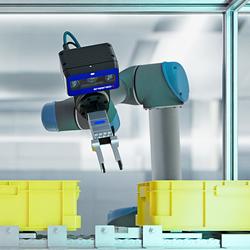
3D Vision: Ensenso B now also available as a mono version!
This compact 3D camera series combines a very short working distance, a large field of view and a high depth of field - perfect for bin picking applications. With its ability to capture multiple objects over a large area, it can help robots empty containers more efficiently. Now available from IDS Imaging Development Systems. In the color version of the Ensenso B, the stereo system is equipped with two RGB image sensors. This saves additional sensors and reduces installation space and hardware costs. Now, you can also choose your model to be equipped with two 5 MP mono sensors, achieving impressively high spatial precision. With enhanced sharpness and accuracy, you can tackle applications where absolute precision is essential. The great strength of the Ensenso B lies in the very precise detection of objects at close range. It offers a wide field of view and an impressively high depth of field. This means that the area in which an object is in focus is unusually large. At a distance of 30 centimetres between the camera and the object, the Z-accuracy is approx. 0.1 millimetres. The maximum working distance is 2 meters. This 3D camera series complies with protection class IP65/67 and is ideal for use in industrial environments.