Swarms of Robots Manage to Not Run Into Each Other
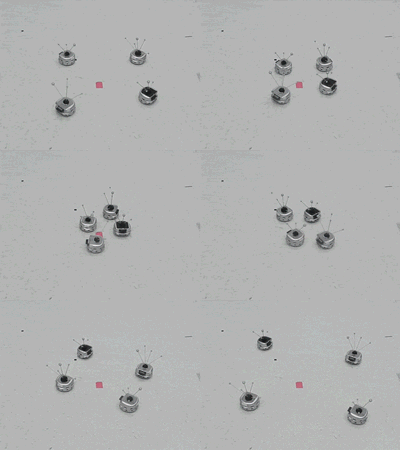 Evan Ackerman for IEEE Spectrum: At Georgia Tech, Li Wang and professors Aaron D. Ames and Magnus Egerstedt have been developing ways to allow infinitely large teams of mobile robots to move around each other without colliding, and also without getting in each other’s way. This is very important for people like me, who have 37Roombas at home, but also for anyone imagining a future where roads are packed with autonomous cars.
The fundamental issue here is robot paranoia. When robots move around, they typically maintain a sensor-based “panic zone” for safety, and if anything enters that space, they panic, and stop moving. If you have only two robots moving around, they can keep clear of one another, but as the number of robots increases, the odds that two “panic zones” will intersect also increases, to the point where they overlap and you just end up with a completely paralyzing global robot freakout. Or as the Georgia Tech researchers put it (in a much fancier way), “as the number of robots and the complexity of the task increases, it becomes increasingly difficult to design one single controller that simultaneously achieves multiple objectives, e.g., forming shapes, collision avoidance, and connectivity maintenance.” Cont'd...
Featured Product